
I prepare leaders for the moments that are judged
I’ve coached performers through Europe's toughest auditions. The same method gets leaders through the room that decides.
25 minutes. Confidential, no pitch.
Dein Inhalt kommt hierhin. Bearbeite oder entferne diesen Text inline oder in den Inhalteinstellungen des Moduls. Du kannst außerdem jeden Aspekt dieses Inhalts in den Designeinstellungen des Moduls gestalten und sogar benutzerdefiniertes CSS auf diesen Text in den Erweitert-Einstellungen des Moduls anwenden.
Dein Inhalt kommt hierhin. Bearbeite oder entferne diesen Text inline oder in den Inhalteinstellungen des Moduls. Du kannst außerdem jeden Aspekt dieses Inhalts in den Designeinstellungen des Moduls gestalten und sogar benutzerdefiniertes CSS auf diesen Text in den Erweitert-Einstellungen des Moduls anwenden.
You're very good at your job. And yet.
You know your subject. You've read the room before. You've handled difficult people and questions you didn't see coming. And yet there are still those moments.
The point you made that landed flat — until someone said it louder, and the room responded to them. The meeting where your message didn't land the way it lived in your head. The board presentation you're more than qualified to lead, and still dread the night before. The version of you that's sharp and convincing one-to-one, that somehow shifts the moment there are ten people in the room.
Nobody tells you this is normal. And nobody tells you it's fixable.

Tracey Grey
Performer. Founder. Coach.
Tracey Grey
Performer. Founder. Coach.
I've performed under judgement
Twenty years on stage and screen — where every audition, every opening night, is a single moment assessed in real time. I know what that pressure does to the body and the voice, because I've worked in it.
I've built and sold a business
I founded a theatre school, grew it from 0 students to 180 across three locations, and sold it. I carried the P&L. I know the gap between performing well and running something.
I coach at your level
Certified systemic coach (DCV, IOBC) and certified arts educator. I work as part of the consulting team at NoTool, on leadership, change and team development.
I understand the politics, the stakes, and the rooms you're walking into.
It was never about the content
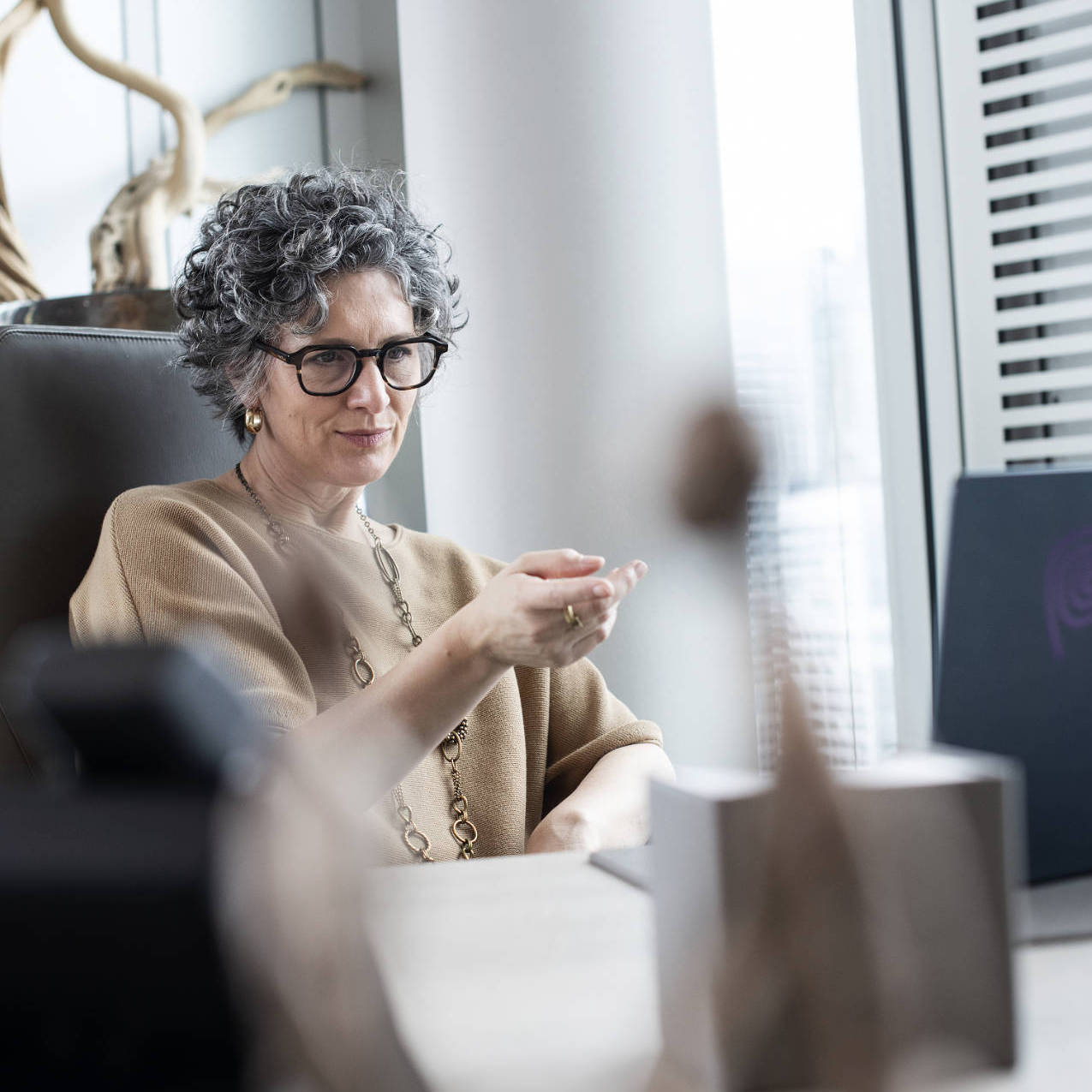
High-stakes communication isn't a knowledge problem. It's a connection problem. Somewhere in the first few minutes of a meeting that matters, you realise the room isn't responding to what you're saying — it's responding to you.
Most training never goes there. It works on the symptoms — nerves, speed, the monotone, the slides — and leaves the root untouched. So you walk in knowing the material cold and still sound like you're not sure. The root is a set of physical and mental patterns you built, years ago, as protection. Until those are interrupted at the source, nothing sticks. That's why the books, the workshop, the "just breathe" never moved anything.
This is where theatre-trained is different from corporate-trained. Corporate training hands you a framework — a deck to follow. Theatre teaches you how to inhabit a moment: how to use your body, breath, silence and attention as instruments. One works until the script runs out. The other changes how you show up when there is no script — which is every moment that actually counts.
And here's the part nobody names: you're looking for proof that you're enough. The work gives you the ability to feel it first — and the proof follows. That's the inversion most people never see.
Start with the framework.
The High-Stakes Communication Playbook.
Before you download it, here's why I wrote it.
Not tips, not scripts — a way of thinking about the moments that matter: before you walk in, in the first twenty seconds, when the room shifts, and after. You'll find your own pattern in it, and the small, precise adjustments that close the gap between what you know and the impact you make. It's the same framework I use with senior leaders, and it's yours, free.
Proof sits in what my clients did next
The performers I coached went on to pass auditions at some of Europe's toughest schools — the Max Reinhardt Seminar in Vienna, the Institute of Arts Barcelona, Trinity Laban and Italia Conti. An audition is the purest judged moment there is: one attempt, decided in the room, with your identity on the line. A board presentation has the same shape.
Today this work happens inside organisations, including through my role at NoTool. I don't publish client names — at your level, discretion is part of the service. But a few have chosen to speak for themselves:
I'm happy to put you in touch with someone who's worked with me.
Elena Hergass
Global Co-Head Corporate Bank Operations, Deutsche Bank
Denise E.
Projektmanagerin bei einem Energieversorger
Five sessions. Nine weeks. Built around the room you're walking into next.

A private 1:1 engagement, online or hybrid, anchored in your real, high-stakes contexts — not abstract exercises. Sophisticated, discreet, and practical from the first hour: most leaders leave the first session with one or two adjustments that immediately change how their message lands.
One adjustment in a session isn't the goal. Repetition under real pressure is. Over nine weeks, we practise in conditions close enough to the real thing that the new behaviour holds when it counts — until the version of you that commands a room is no longer an occasional glimpse, but one you can reach on demand.
25 minutes. Confidential, no pitch..
Knowing what to do and being able to do it under pressure are two very different things.
That's the work.